
The university for the real world
Explore a diverse range of disciplines, allowing you to advance your career in an industry of your choosing
A world-class qualification
As one of Australia’s leading universities, QUT is internationally recognised through rankings. Our dedication to learning and success has produced many outstanding alumni.
Graduating from QUT Online means earning a globally respected degree from an institution ranked among the top 250 in the world. Take your career to the next level as you benefit from world-class research, industry connections and a competitive degree that sets you apart.
QS World University Rankings 2026
QS World University Rankings by Subject 2025

Times Higher Education World University Rankings (Global top 250)
Times Higher Education Impact Rankings 2024
Select a discipline and level of study
What I want to study
The level of study
IT Bootcamps
- Feb, Jul
- 6 months full-time or part-time equivalent
Project Management
- Feb, Apr, Jul, Oct
- 1 year, 1.5 years or part-time equivalent
Justice
- Feb, Apr, Jul, Oct
- 1.5 years or 3 years part-time equivalent
Information Technology (IT)
- Feb, Apr, Jul, Oct
- 2 years full-time or part-time equivalent
Information Technology (IT)
- Feb, Apr, Jul, Oct
- 2 years full-time or part-time equivalent
Information Technology (IT)
- Feb, Apr, Jul, Oct
- 1.5 – 2 years full-time or part-time equivalent
Information Technology (IT)
- Feb, Apr, Jul, Oct
- 1.5 – 2 years full-time or part-time equivalent
Information Technology (IT)
- Feb, Apr, Jul, Oct
- 2 years full-time or part-time equivalent
Health
- Feb, Apr, Jul, Oct
- 1.5 years or part-time equivalent
Education
- Feb, Apr, Jul, Oct
- 1–1.5 years full-time (depending on prior qualifications and experience)
Business
- Feb, Apr, Jul, Oct
- 1.5 years or 3 years part-time equivalent
Justice
- Feb, Apr, Jul, Oct
- 1 year or 2 year part-time equivalent
Information Technology (IT)
- Feb, Apr, Jul, Oct
- 1-year full-time or part-time equivalent
Information Technology (IT)
- Feb, Apr, Jul, Oct
- 1-year full-time or part-time equivalent
Information Technology (IT)
- Feb, Apr, Jul, Oct
- 1 year full-time or part-time equivalent
Information Technology (IT)
- Feb, Apr, Jul, Oct
- 1 year full-time or part-time equivalent
Information Technology (IT)
- Feb, Apr, Jul, Oct
- 1 year full-time or part-time equivalent
Information Technology (IT)
- Feb, Apr, Jul, Oct
- 1-year full-time or part-time equivalent
Health
- Feb, Apr, Jul, Oct
- 1 year or part-time equivalent
Project Management
- Feb, Apr, Jul, Oct
- 6 months full-time or part-time equivalent
Justice
- Feb, Apr, Jul, Oct
- 6 months full-time or 1 year part-time equivalent
Justice
- Feb, Apr, Jul, Oct
- 6 months full-time or part-time equivalent
Justice
- Feb, Apr, Jul, Oct
- 6 months full-time or part-time equivalent
Information Technology (IT)
- Feb, Apr, Jul, Oct
- 6 months full-time or part-time equivalent
Health
- Feb, Apr, Jul, Oct
- 6 months full-time
Health
- Feb, Apr, Jul, Oct
- 6 months full-time
Education
- Feb, Apr, Jul, Oct
- 6 months full-time or part-time equivalent
Education
- Feb, Apr, Jul, Oct
- 6 months full-time or part-time equivalent
Education
- Feb, Apr, Jul, Oct
- 6 months full-time or part-time equivalent
Education
- Feb, Apr, Jul, Oct
- 6 months full-time or part-time equivalent
Justice
- Feb, Apr, Jul, Oct
- 6 months full-time or part-time equivalent
Information Technology (IT)
- Feb, Apr, Jul, Oct
- 6 months full-time or part-time equivalent
Information Technology (IT)
- Feb, Apr, Jul, Oct
- 6 months full-time or part-time equivalent
Information Technology (IT)
- Feb, Apr, Jul, Oct
- 6 months full-time or part-time equivalent
Information Technology (IT)
- Feb, Apr, Jul, Oct
- 6 months full-time or part-time equivalent
Business
- Feb, Apr, Jul, Oct
- 6 months full-time or 1 year part-time equivalent
IT Bootcamps
- Apr, Oct
- 6 months full-time or part-time equivalent
IT Bootcamps
- Feb, Jul
- 6 months full-time or part-time equivalent

Learn in your way
Don’t put your life on hold, make your studies work for you
Our expert advisors are here to guide you through your results and provide you with the information you need to take the next step.
What is it like to study with QUT Online?
QUT Online offers a flexible and dynamic learning environment tailored to meet the needs of the modern student.
Gain insight into what your learning journey will look like as a QUT Online student. From discovering your perfect postgraduate course to graduating with a qualification that makes your career future-proof, your online journey is mapped out in this video.

Click to learn about the student hub | Duration: 3:53
Core Study Areas
Courses we provide
Study toward your world-class postgraduate qualification online.

Why study with QUT Online?
QUT Online offers students the unique opportunity to study toward their dream postgraduate qualification in a flexible way that suits their work, family and other life commitments.
Our courses are structured to allow you to adapt your studies to pursue your goals, giving you the option to study part-time or full-time. Most importantly, you will not be alone during your studies – our dedicated support team is always on hand to guide you to success.
Study Modes
Flexible options – choose your level of study
Micro units
Single unit
Degrees
What our students say
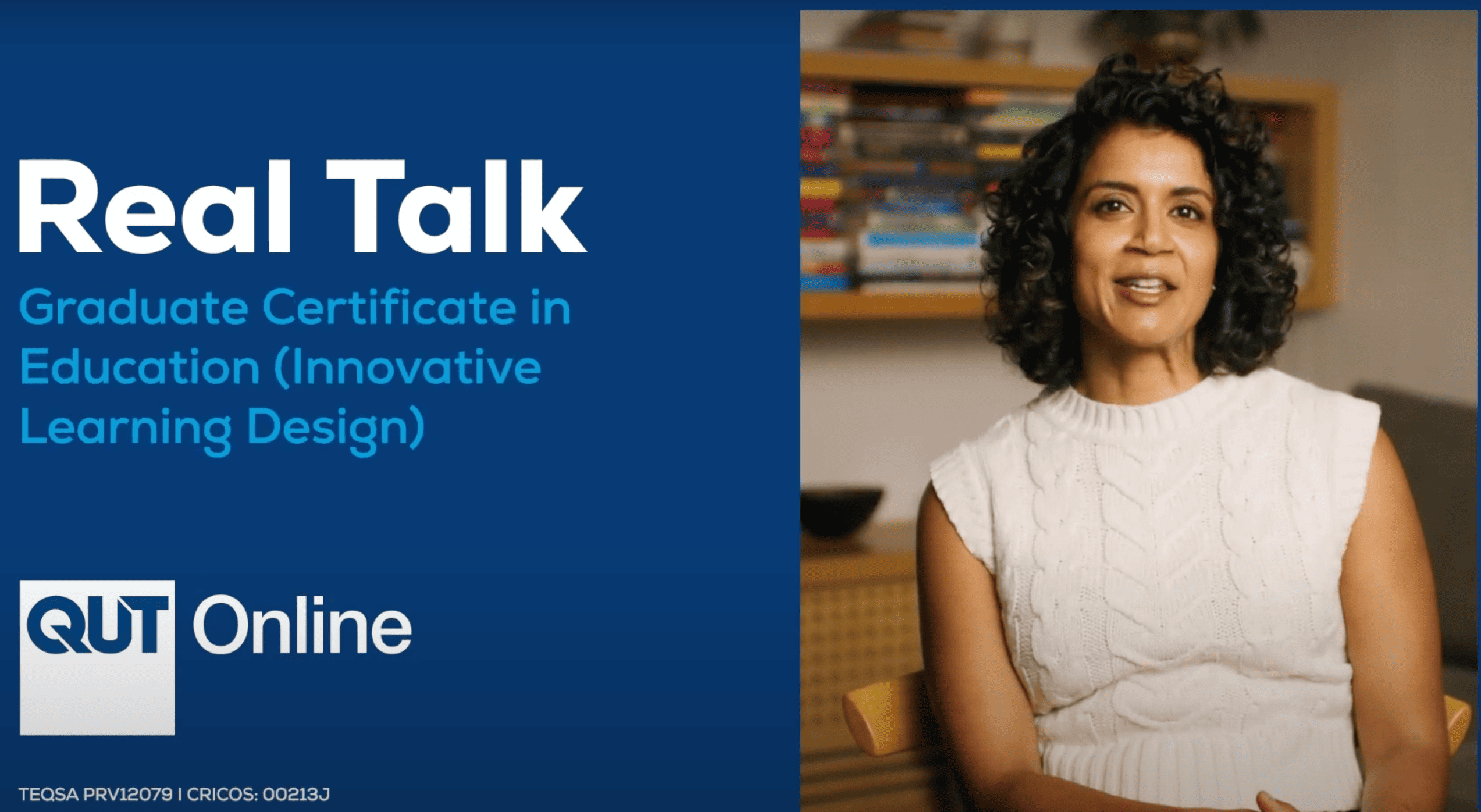
I narrowed it down; I knew I wanted to do learning design. I found studying at QUT Online was modern, and pointed. Something I could sink my teeth into.Brigitte, Graduate Certificate in Education (Innovative Learning Design)
Personalised Support
Rest assured, we’ve got your back every step of the way


Support team
Our student advisors are available 7 days a week, ensuring that all your questions have answers.

Online Learning Advisors (OLAs)
Each unit is led by an Online Learning Advisor (OLA), bringing industry expertise to your studies.

Online Community
Join the QUT online community and share knowledge with fellow postgraduate students.

Assignment assistance
Whether you need help with referencing, want feedback on the first draft of an essay or would like to discuss a weekly study topic further – we’ve got you.
Ready to apply?
Apply for your dream qualification by filling out our application form, or speak with one of our Course Consultants on 1300 104 196 to discover the right study option for you.
Latest blogs
Keep up to date with all things QUT, delving into valuable information about your career prospects and how to get the most out of your online studying.

Returning to study: What experienced professionals gain from postgraduate education
Returning to study can be a powerful step towards achieving your career goals. Discover the key benefits of postgraduate study, from advancing your expertise and expanding career opportunities to building confidence and staying competitive in a changing workforce. This guide explores how further study can support your professional growth while fitting around your existing commitments.

How to become a principal in Australia
Considering a move into school leadership? Learn how to become a principal in Australia, from building leadership experience to developing the skills needed to lead a school community. Discover whether principalship is the right next step in your education career.

Six cyber security trends shaping Australian organisations
Cyber security is no longer just an IT issue. As organisations across Australia respond to evolving threats, AI-driven risks and growing resilience requirements, cyber security is becoming a business-wide priority. Explore six key trends shaping the future of cyber security and discover the skills increasingly valued by employers across government, technology, finance and beyond.

Healthcare management and leadership: What it looks like in practice
Healthcare management and leadership involves improving services, supporting teams, managing change and making informed decisions. Explore what this looks like in practice, the skills leaders need, and how postgraduate study can support your next career step in health leadership.

What is career development and counselling? Skills you need to succeed
Career development and counselling help people make informed decisions about work, study and career transitions. Discover how the field differs from related professions, where practitioners work, and the skills needed to succeed.

Investigations and intelligence explained: how professionals identify risk and prevent harm
Investigations and intelligence help organisations identify risks early, interpret complex information, and prevent harm. This sector offers a practical pathway into decision‑making roles grounded in evidence, analysis, and governance. This article breaks down what each field involves, the kinds of issues investigated in Australia, and how postgraduate justice studies can build the applied skills to work confidently across both government and private sector contexts.
Contact us
Contact us through the enquiry form below and one of our expert Course Consultants will get back to you with the help you need.
Talk to us
Get in touch with one of our support staff who are always ready to guide you.
9am – 5pm AEST Monday to Friday
Book a call today