
Investigations and intelligence play a central role in how organisations identify issues, manage risk, and protect communities and enterprises. These functions extend well beyond law enforcement, shaping how government agencies, regulators, and private organisations respond to complex challenges. Professionals in these roles work with information and evidence to support decisions that have real-world impact across policy, compliance and governance environments.
For those considering a career shift into justice, policy or regulatory work—as well as those already working in the field who want formal certification and career advancement—investigations and intelligence offer a practical pathway. These roles focus less on frontline enforcement and more on structured decision-making, analysis and problem-solving, making them suitable for professionals who want to influence outcomes through insight and evidence.
What do ‘investigations’ and ‘intelligence’ mean?
Investigations and intelligence are distinct but closely connected disciplines that inform how organisations respond to criminal risk. Investigations focus on establishing facts through structured, evidence-based processes, such as the Australian Government Investigations Standard. This involves gathering information, assessing its reliability, and producing findings that can support decisions, compliance actions, or organisational responses.
Intelligence, by contrast, is centred on analysis. Professionals analyse information from a range of national and international sources to produce reliable insights. Analysts are expected to continuously update their skills as their roles evolve, to ensure efficiency and accuracy.
Rather than focusing only on past events, intelligence helps organisations anticipate challenges and plan their response. Together, these functions operate through ongoing cycles in which information is collected, analysed, shared, and refined to support continuous decision-making.
What kinds of problems are investigated in Australia?
Investigations in Australia cover a wide range of matters that affect both organisations and the public, from regulatory and compliance breaches to fraud, corruption, serious workplace misconduct, cyber-related incidents, and environmental or safety risks. While some investigations relate to criminal activity, many are administrative in nature and focus on establishing facts, assessing whether obligations have been met, and supporting fair, defensible decisions.
Other investigations examine workplace conduct, environmental risks, or organisational failures that may lead to harm. In these contexts, investigators play an important role in ensuring that systems function as intended and that organisations meet their legal and ethical obligations. This type of work requires strong analytical thinking, attention to detail, and the ability to interpret evidence within complex governance frameworks.
How intelligence is used beyond enforcement
Intelligence supports organisations in moving beyond reactive approaches and adopting more proactive strategies. By analysing data and information, intelligence professionals can identify trends and highlight emerging risks for enterprises and governments. This allows organisations to prioritise their resources and focus their efforts where they are most needed. The Office of National Intelligence outlines seven key ways intelligence serves Australia beyond enforcement:
- Collection – Gathering information from overt, covert, and open-source sources
- Assessments – Producing substantiated judgments on issues and their likely implications for strategic and operational decision-making
- Partnerships – Working with academia, businesses, civil society, government levels, and international partners
- Intelligence diplomacy – Building relationships and conveying messages to advance Australia’s diplomatic priorities
- Disruptions and effects – Actively disrupting or influencing activities harmful to Australian interests
- Investigations – Supporting security and criminal investigations beyond law enforcement
- Advice – Providing guidance to government, businesses, civil society, academia, and the public to inform decision-making
In practice, intelligence informs prevention strategies by helping organisations understand how risks develop over time. This insight supports effective policy decisions, enabling the implementation of measures that reduce harm before it occurs.
Influencing policy reform and systemic change
Investigations and intelligence contribute to longer-term outcomes. They provide insight into how systems function, where gaps exist, and how organisations can improve their approach to risk and governance.
The connection between analysis and impact is a defining feature of investigations and intelligence work. Postgraduate justice study helps develop this capability, preparing graduates to move beyond individual cases and contribute to policy development, organisational reform, and long-term decision-making.
How postgraduate justice study prepares professionals
Postgraduate justice studies provide a clear structure for developing the skills required for investigations and intelligence roles. Rather than focusing solely on theory, courses emphasise applied learning, giving students a realistic understanding of professional practice.
The Graduate Certificate in Investigations and Intelligence at QUT Online equips students to apply investigative and intelligence processes to manage and deliver complex projects. It also develops the capability to analyse trends and plan responses to future risks, accurately reflecting the dual focus of investigations and intelligence work.
The course also builds ethical, social, and analytical capabilities, preparing graduates to apply these skills in real-world investigations and intelligence contexts. Graduates develop the ability to make defensible, evidence-based decisions, demonstrate accountability for outcomes, uphold procedural fairness in high-stakes environments, and navigate complex governance frameworks including AGIS 2022 and the Evidence Act 1995 No 25 helps graduates build trust through transparent, legally sound practices. It also prepares them to operate in environments subject to court scrutiny and public oversight. helps graduates build trust through transparent, legally sound practices. It also prepares them to operate in environments subject to court scrutiny and public oversight.
Career‑focused learning aligned to senior roles
A key strength of this area of study is its alignment with professional expectations. Investigations and intelligence roles often require a combination of analytical capability, ethical judgement and practical experience, particularly at more senior levels.
QUT Online’s Graduate Certificate in Investigations and Intelligence is designed to reflect industry selection criteria, ensuring that graduates develop skills that directly match job requirements. This focus on applied capability, combined with real-world assessment tasks, helps bridge the gap between study and employment, particularly for those looking to transition into more specialised or leadership roles.
Career pathways across investigations, intelligence and policy
Career pathways in investigations and intelligence extend across multiple sectors, reflecting demand for these skills across Australia.
In government and justice agencies, professionals work in investigation units, regulatory bodies, or intelligence teams that support decision-making at local, state, and federal levels.
Beyond government, organisations in the private and not-for-profit sectors also rely on these capabilities. Roles in compliance, risk management, and policy development require professionals who can analyse information, identify issues, and contribute to organisational strategy.
This range of opportunities highlights the versatility of investigations and intelligence as a career pathway. Graduates can pursue the following career pathways:
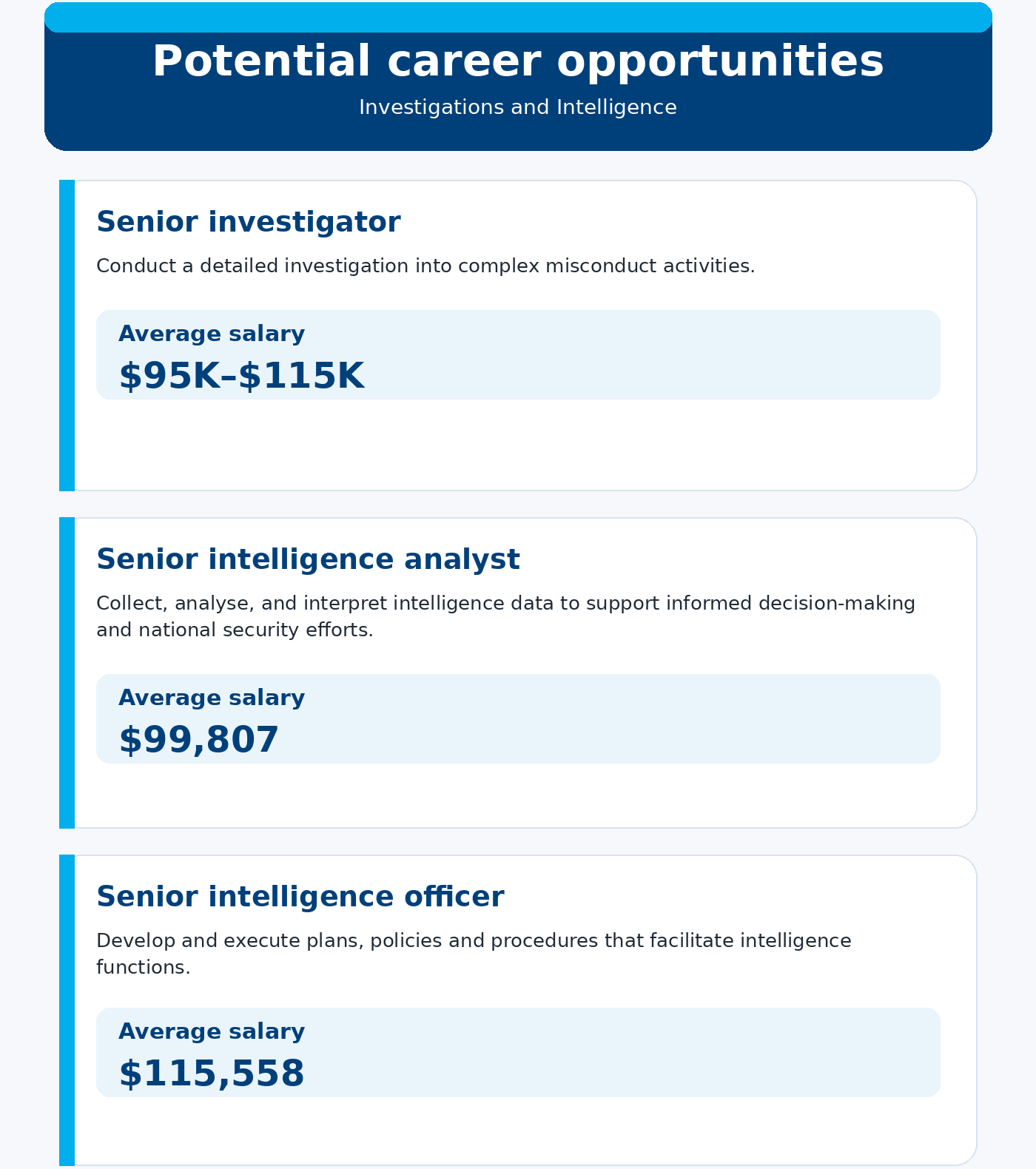
Source: Seek.com.au
Your next steps
Investigations and intelligence are grounded in clear thinking, structured processes, and informed decision-making. For professionals who want to move into roles that shape how organisations respond to risk and protect the public, building these capabilities is a practical next step. A course such as the Graduate Certificate in Investigations and Intelligence at QUT Online can provide a clearer understanding of how these skills apply in real-world contexts and align with evolving career pathways in justice and policy.
If you are ready to take the next step in your investigations and intelligence career, apply now or contact us at 1300 104 196 and one of our Course Consultants will be happy to answer any questions you have.