
Join our upcoming webinar on the Graduate Certificate in Education (Innovative Learning Design). Register now.
As learning and education move online and/or into blended formats, employers are looking for professionals who can design courses that are well-structured, accessible, and backed by evidence. The focus is on creating online learning experiences that are easy to navigate and designed around how students typically learn.
For professionals considering postgraduate studies in education, learning design provides a clear pathway into a future-focused field. It is particularly valuable for experienced educators, trainers, and professionals who wish to formalise their expertise in digital learning, curriculum development, or learning and development teams.
What is learning design?
Put simply, learning design is the overarching framework that supports online and blended learning. The term refers to the decisions made regarding content, structure, timing, pedagogy, and sequence of activities. The approach draws on adult learning principles and contemporary educational theory.
Rather than focusing only on delivering content, learning designers consider how learning is experienced. This includes how content is sequenced, how students are supported through activities and assessment, and how digital environments are used to promote understanding and engagement. Learning design principles guide decisions about which materials and resources to use, which activities will best support learning, and how to structure a course from start to finish.
Learning design is distinct from teaching, content writing, or system administration. While it often involves close collaboration with educators and subject matter experts (SMEs), its core purpose is to create coherent, effective learning experiences that benefit all students.
What does a learning designer do in practice?
Learning designers work across any industry where learning occurs. This includes universities, corporate learning environments, and government agencies. While responsibilities vary by setting, the focus is consistent: design accessible and effective end-to-end learning experiences.
In practice, learning designers will identify learning gaps by collaborating with stakeholders and SMEs, create a course blueprint, and build learning materials using tools such as Articulate Storyline, Rise, or Canva. Courses are then quality-checked and evaluated for effectiveness before being released to learners. The infographic below visualises the basic workflow of a course developed by learning designers.
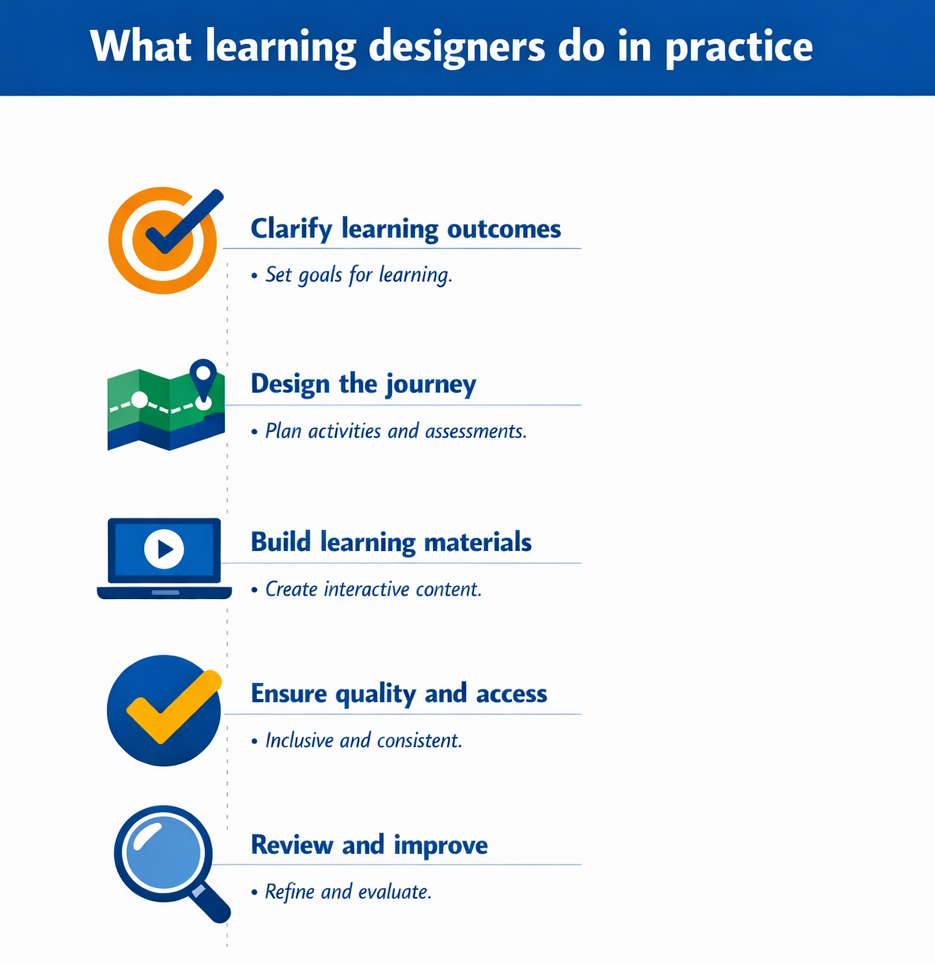
Learning designers do more than upload approved academic content to a learning platform. They play a key role in shaping how content is presented, assessed, and experienced to support effective learning.
Skills employers look for in learning designer roles
Now that we have explored the specifics of a learning designer role, let’s look at the skills employers seek when hiring.
Although tools and platforms vary across organisations, the skills employers value remain largely consistent within the Australian job market. These in-demand capabilities centre on design judgement, collaboration, and professional practice, rather than narrow technical expertise. These skills can be further broken down into soft and hard skills.
Soft skills
- Innovation: Design engaging, learner-centric experiences by using digital methods such as gamification and storytelling
- Problem-solving: Efficiently addressing content gaps or technical issues
- Communication: Clearly articulate designs to collaborating teams and students
- Curation and collaboration: Source or reuse content while working with SMEs
Hard skills
- Research: Conduct in-depth analyses of learning gaps to inform the final course design
- Understanding: Possess clear and demonstrable knowledge of learning frameworks like ADDIE or SAM and other adult learning principles
- Assessment design: Create evaluations and feedback mechanisms that align with AQF (Australian Qualifications Framework) standards
- Data-driven design: Use analytics to iterate and measure learning outcomes
While the skills outlined above are important for your role as a learning designer, it is worth noting that the list is not exhaustive. Additional skills may be required depending on the specific context and demands of the industry in which you choose to work.
Why employers expect more than content development
Australian employers increasingly recognise that high-quality online learning depends on design, not just content. As a result, learning designer jobs tend to emphasise capability in learning design rather than technical production alone.
Employers value learning designers who can apply learning theory, design meaningful assessment and feedback, and evaluate whether learning experiences are achieving their intended outcomes. The ability to improve learning experiences over time is especially important in digital environments, where learner behaviour and engagement can be analysed and improved.
This shift has positioned learning design as a specialist role that combines educational expertise with digital capability and strategic thinking.
How postgraduate study supports learning design careers
Postgraduate study in education and learning design provides essential advanced knowledge and practical skills that align directly with employer expectations in Australia, helping professionals transition into impactful roles. Graduates will develop a deep understanding of the core principles of learning and instructional design, with a contemporary grasp of andragogy in digital learning contexts.
Key areas covered include:
- Digital pedagogy and learner analytics for data-informed design
- Inclusive and culturally responsive principles to meet diverse learner needs
- Emerging technologies like AI personalisation for innovative solutions
Graduates gain proficiency in tools such as Articulate Storyline and Moodle, as well as soft skills such as stakeholder collaboration, ethical decision-making, and adaptive problem-solving. Programs often feature real-world projects and networking to enhance employability and career growth.
For a targeted and flexible entry, consider QUT Online’s Graduate Certificate in Education (Innovative Learning Design), an online option suited to Australian professionals balancing work and study.
Summary and next steps
Learning designer jobs in Australia reflect a growing demand for professionals who can design effective, inclusive, and evidence-based learning experiences in digital environments. Employers are looking beyond content creation towards learning design capability grounded in theory, practice, and evaluation.
For professionals considering postgraduate study, the Graduate Certificate in Education (Innovative Learning Design) from QUT Online offers a focused pathway into this field. The course builds practical learning design skills supported by adult learning theory, while allowing students to study fully online alongside professional commitments.
You can apply online, download the course brochure, or book a call with a QUT Online Course Consultant to explore whether this course aligns with your career goals and experience.